
Dental Financing Options: Credit Types, Risks, and How to Avoid Deferred-Interest Traps
This page covers credit-based dental financing only: loans, promo credit, and third-party financing products.
If you’re looking for safer non-credit ways to pay first—cash discounts, staged treatment, savings plans, and office payment plans—start here:
Dental Payment Options →
Dental financing isn’t “one thing.” It’s a handful of products that can look similar at the front desk but behave very differently after you sign. This hub is built to help you choose a financing type that matches your payoff horizon—and avoid the two failures that repeatedly show up in consumer complaints and regulator warnings:
- Deferred interest: interest can accrue from the purchase date and may be charged retroactively if you don’t pay the promo balance in full by the deadline. CareCredit explains this structure directly. (carecredit.com)
- Low-transparency financing in healthcare settings: the CFPB has reported that medical credit cards and financing plans can involve confusion and financial risk for consumers. (consumerfinance.gov)
Why financing mistakes happen at the dental office (financing desk reality)
Most financing errors don’t come from bad intent—they come from time pressure. Financing is usually discussed after diagnosis, when patients are processing cost, urgency, and emotion at once. In that setting, people anchor on the monthly payment and miss the penalty trigger.
That’s why deferred-interest products create complaints: the risk is real, but the decision environment is distorted. (consumerfinance.gov)
The one “source of truth” you must understand
If an offer says “No interest if paid in full within X months,” treat it as deferred interest until proven otherwise.
Deferred interest (canonical explanation)
Interest accrues from the purchase date. If the promotional balance is not paid in full by the end of the promotional period, the accrued interest may be added back. CareCredit describes this directly in its promotional financing guidance. (carecredit.com)
Verify:
“Is this deferred interest, or is it a true installment plan with a stated APR and payoff schedule?” (consumerfinance.gov)
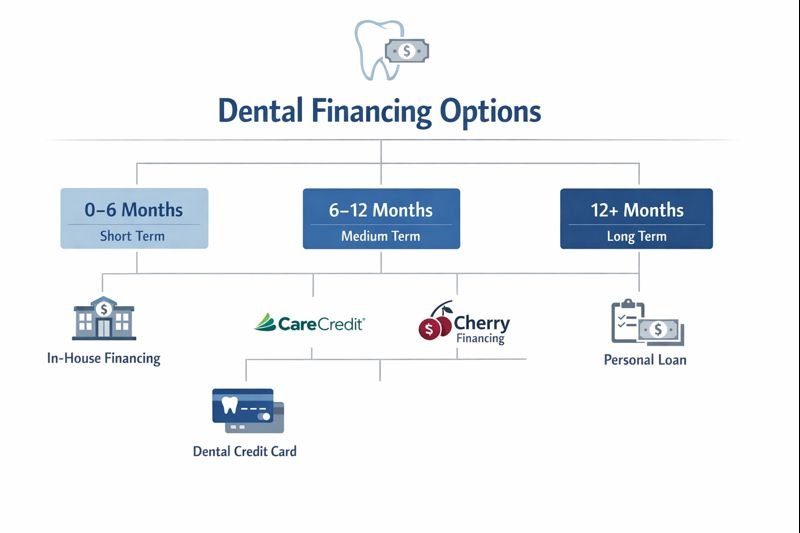
Dental Financing Options Menu (Credit Products)
1) In-house dental financing (office-run plan)
Best for: You want predictable payments without promo-credit traps.
What it is: A payment arrangement with the dental loan office when offered (not always available).
Risk controls (non-negotiable):
- Deposit required (yes/no + amount)
- Term length (months)
- Fees or interest (and total repayment)
- Late rule (fees, treatment pause, collections)
- What happens if treatment changes mid-course
Quick verdict: Often the safest credit-adjacent option if the terms are written and simple.
2) Personal loan (installment loan)
Best for: Larger balances and 12+ month horizons where you want a clean payoff date.
What it is: A lender offers a stated APR and a fixed schedule with a defined end date.
Risk controls:
- Compare total repayment, not the monthly payment
- Confirm origination fees and prepayment rules
- Borrow only what you are actually committing to
Quick verdict: Best long-horizon stability when the rate is reasonable.
3) Medical/dental credit cards (promotional financing)
Best for: You can pay the promo balance in full before the deadline—comfortably.
What it is: Often a revolving credit line using promotional financing structures.
Key risk: This is often deferred interest.
Operational control: Your plan must hit $0 one month early to create buffer for billing, timing, and allocation surprises.
Quick verdict: High leverage when executed like a deadline contract; high penalty when it drifts.
4) CareCredit for dental
CareCredit’s promotional financing can include deferred-interest structures. (carecredit.com)
CareCredit risk-control box:
- Ask for the exact promo term (6 / 12 / 18 / 24 months)
- Treat the promo end date as a hard deadline
- Pay to $0 one month early
- Keep the promo purchase isolated
- Screenshot the promo terms you accepted
Quick verdict: Works when you run a strict payoff calendar; fails when you treat it like “minimum payments.”
5) Cherry dental financing
Cherry describes dental payment plans that can range from short interest-free options to longer terms with qualifying 0% APR or stated APR depending on eligibility. (withcherry.com)
Risk controls:
- Confirm whether your offer is 0% APR vs a stated APR plan
- Ask for total repayment (not just monthly)
- Confirm late fees and how treatment changes affect the plan
Quick verdict: cherry dental financing Often easier to reason about than deferred interest—if you read the offer details.
6) Other third-party dental financing
Best for: You’ve compared at least two paths and the terms are plain.
The CFPB has highlighted patient confusion and risks in medical credit cards and financing plans used in healthcare settings. (consumerfinance.gov)
Risk controls:
- Identify product type: installment vs revolving vs deferred interest
- Demand payoff schedule and penalty triggers in writing
- Treat vague explanations as a “no”
Quick verdict: Safe when transparent; dangerous when rushed.
Real-world failure scenario (memorability boost)
A patient finances implants on a 24-month promo, then adds a crown six months later. The new charge creates a second promotional bucket with a different deadline. Minimum payments get allocated in a way the patient didn’t expect. At month 24, one bucket is paid off, the other isn’t—so deferred interest triggers on the remaining bucket. (carecredit.com)

How to choose the right financing option (decision rules)
Rule 1: Choose by payoff horizon
- 0–6 months: Promo credit only if you can finish early; otherwise office plan or short installment
- 6–12 months: Office plan or installment; promo credit only with buffer payoff plan
- 12+ months: Installment loan where total repayment is visible upfront
Rule 2: Match financing to treatment timeline
Staged treatment creates scope change. If your financing structure punishes “not paid in full by X date,” it’s brittle—build buffer or choose installment.
Rule 3: Monthly payment is not the metric
The metric is: total repayment + penalty trigger + your ability to execute the plan.
Verify-Before-You-Sign Checklist (Pass/Fail)
If you can’t answer these cleanly, don’t sign.
- Product type: installment loan, revolving credit, or deferred interest promo (consumerfinance.gov)
- Total repayment: “If I follow this plan perfectly, what will I pay total?”
- Promo type: deferred interest vs stated APR installment
- Exact deadline: promo end date and time
- Penalty trigger: “If I’m $1 short at the deadline, what happens?” (in writing)
- Minimum payment reality: minimum payments may not pay off the promo balance before promo end
- Fees: origination, late fees, returned payment fees
- Treatment change rule: what happens if additional procedures are added?
Verify line:
“If I don’t pay the promo balance in full by the deadline, is interest charged from the purchase date?”
Scripts (copy/paste)
Script 1 — product clarity
“Is this an installment plan with a stated APR and payoff schedule, or is it promotional financing like deferred interest?”
Script 2 — penalty trigger
“If I’m short by any amount at the end of the promo period, is interest charged from the purchase date?”
Script 3 — total cost
“I’m deciding by total repayment, not monthly payment. What is the total I will repay if I follow this plan?”
Bottom line
The best dental financing option is the one you can explain in one sentence:
“I know the total repayment, the deadline, the penalty trigger, and exactly how I’ll pay it off.”
If financing feels risky, step back and review non-credit ways to pay first →
https://dentalcostadvisor.com/dental-payment-options/
FAQs
What is the safest dental financing option
Usually the safest is the clearest written structure: an in-house office plan with transparent terms or a straightforward installment loan with a stated payoff schedule.
Can minimum payments pay off promo financing in time
Not always. Minimum payments may or may not pay off the promotional balance before the promotional period ends. (carecredit.com)
Is dental financing the same as a dental payment plan
Not necessarily. An in-house payment plan is run by the dental office. Financing often involves third-party credit products or loans.